A best reputation management tool should do more than show your latest Google rating. It should help a business understand what customers are saying, detect reputation risks early, respond appropriately, and turn customer signals into better decisions.
Imagine a restaurant in Karachi with a 4.4-star rating. On paper, the reputation looks healthy. But its recent comments increasingly mention slow service. Without sentiment analysis, trend tracking, and timely alerts, management may not notice the pattern until more customers start complaining publicly.
That is why choosing reputation software should be about actionable capabilities, not the longest feature list.
What Is a Reputation Management Tool?
A best reputation management tool is software that helps businesses monitor, analyze, and improve how customers perceive them across reviews, ratings, feedback channels, and other reputation signals.
A useful platform can bring together review monitoring, sentiment analysis, response workflows, alerts, analytics, and location-level reporting so teams can identify issues and
What Should the Best Reputation Management Tool Include?
The right tool should cover the complete reputation workflow rather than focusing on one feature.
Here are the capabilities businesses should evaluate.
1. Review Monitoring and Reputation Tracking
The first requirement is visibility.
Businesses need to know when new reviews arrive and whether customer sentiment is changing.
A useful reputation management system should help track:
Review volume
Average ratings
Rating distribution
Positive and negative sentiment
Review activity over time
Recurring complaints
Location-level reputation
Monitoring becomes particularly important for businesses that receive reviews across multiple branches.
2. Sentiment Analysis and Customer Insights
Star ratings provide a quick signal, but written reviews explain the reason behind that signal.
For example, a customer might leave four stars while repeatedly mentioning long waiting times. If management only monitors the rating, the operational problem can remain hidden.
AI-powered sentiment analysis can help identify positive, negative, and changing themes across larger volumes of customer comments.
Trusted Optics currently provides AI sentiment analysis, NPS, trend detection, and insight generation through its analytics capabilities.
The goal should not be to let AI make every decision. AI should help teams identify where human attention is needed.
3. Real-Time Alerts for Reputation Risks
A reputation issue becomes harder to manage when the business discovers it days later.
Real-time alerts can notify responsible staff when customers leave low ratings or mention critical issues.
Useful alert capabilities include:
Email notifications
SMS alerts
Custom rating thresholds
Keyword triggers
Location-specific alerts
Trusted Optics provides real-time email and SMS alerts with customizable thresholds and keyword triggers.
For example:
Low rating → alert → investigation → customer response → operational action
This creates a faster connection between customer feedback and business response.
4. Negative Feedback Management
A good reputation management platform should not treat negative feedback simply as something to hide.
Negative feedback can reveal service failures, product problems, staff issues, or gaps between customer expectations and the actual experience.
A useful system should support:
Private negative-feedback capture
Alerts
Follow-up workflows
Resolution tracking
Issue categorization
Trusted Optics includes a private inbox, alert system, follow-up workflow, and resolution tracking for negative feedback.
This gives businesses an opportunity to investigate genuine concerns before they become recurring reputation problems.
5. Review Response Management
Monitoring reviews without responding is only half the job.
The platform should make it easier for teams to manage responses consistently while keeping them natural.
Useful features can include:
Response templates
Rating-based routing
Multi-channel responses
Quick-send options
Follow-up workflows
Trusted Optics includes response templates with rating-based routing, multi-channel support, and quick-send functionality.
Templates should provide structure—not replace human judgment. A customer describing a specific service problem should receive a relevant response rather than a generic sentence copied from dozens of other reviews.
6. Analytics Dashboard and Reporting
A reputation management platform should help managers answer more than:
“What is our rating?”
The better questions are:
Which locations are improving?
Where is negative sentiment increasing?
Which complaints appear repeatedly?
Are review interactions increasing?
Which issues require management attention?
Did a recent operational change improve customer sentiment?
An Analytics dashboard Tool can bring these signals together.
Trusted Optics provides custom dashboards, feedback reports, GMB analytics, location insights, location comparison, trend analysis, and PDF reporting.
The best dashboard is not necessarily the one with the most charts. It is the one that helps managers decide what to investigate next.
7. Multi-Location Reputation Management
Managing one business location is very different from managing twenty.
A company-wide rating can look healthy while one branch experiences a serious decline in customer sentiment.
For multi-location businesses, reputation management tools should support:
Location-level reporting
Department tracking
Side-by-side comparisons
Location-specific trends
Centralized management
Branch-level alerts
Trusted Optics provides multi-location management, department tracking, location analytics, and location comparison.
This makes it easier to distinguish between a company-wide issue and a problem isolated to one branch.
8. Integration With Feedback Collection
Reputation management should not begin when a public review appears.
Businesses can also capture customer experiences before they become public reviews.
A Feedback Collection tool can use QR codes, email surveys, SMS, or other digital touchpoints to capture customer responses.
This creates an important distinction:
Public reviews show what customers are saying publicly.
Direct feedback can reveal concerns before they become public.
Analytics connects both signals to broader customer experience patterns.
Trusted Optics supports QR-code collection, email surveys, custom branding, and location-based tracking.
9. Automation Suite for Faster Response
Manual reputation management becomes difficult when review volume increases.
An Automation Suite can reduce repetitive tasks while allowing employees to focus on issues that actually require human judgment.
Useful automation can include:
Review prompts
Rating-based routing
Real-time notifications
Response templates
Follow-up workflows
Scheduled reporting
For example, a high-rated customer can be routed toward a Google review request, while a low-rated customer can be directed toward a private resolution process.
Trusted Optics supports Google review prompting with rating thresholds, Place ID mapping, multi-listing support, and prompt customization.
10. Enterprise Features and Data Security
Larger organizations need more than review monitoring.
They also need control over locations, users, data, and reporting.
Important Enterprise Features can include:
Multi-location management
Department tracking
Secure authentication
Data encryption
Usage controls
Centralized reporting
Priority support
Trusted Optics lists data encryption, secure authentication, JWT tokens, rate limiting, multi-location management, and priority support among its enterprise capabilities.
Data security should be considered from the beginning because customer feedback may contain personal details or sensitive service information.
What About Food Business Review Management Tools?
Restaurants, cafés, bakeries, and other food businesses have a particularly fast-moving reputation environment.
A customer may decide whether to leave a review shortly after dining.
That makes food business review management tools especially useful when they combine:
Quick review collection
QR codes
Real-time alerts
Negative-feedback capture
Google review prompting
Location analytics
Sentiment analysis
For example, if several customers mention slow service during dinner hours, the business can investigate staffing or workflow instead of simply responding to every review individually.
The useful outcome is not just a better review response. It is a better customer experience.
Expert Insight: Don't Optimize Only for a Higher Rating
One of the easiest mistakes is treating the star rating as the entire reputation.
A business can maintain a strong average rating while a recurring problem is becoming more common.
For example:
4.6 rating + increasing complaints about waiting time = potential operational warning
The rating is still positive, but the trend deserves attention.
A strong reputation strategy therefore looks at rating + sentiment + volume + recurring themes + location + time rather than one number in isolation.
How to Choose the Right Reputation Management Tool
Before choosing a platform, ask:
Can it monitor the reputation signals that matter to your business?
Does it identify sentiment and recurring themes?
Can it send real-time alerts?
Can teams manage negative feedback?
Does it support multiple locations?
Can it connect collection with reputation management?
Does its analytics lead to practical decisions?
Are customer data and access properly protected?
Can the platform scale as review volume grows?
A small local business may need only a few of these capabilities, while a multi-location enterprise may require the full workflow.
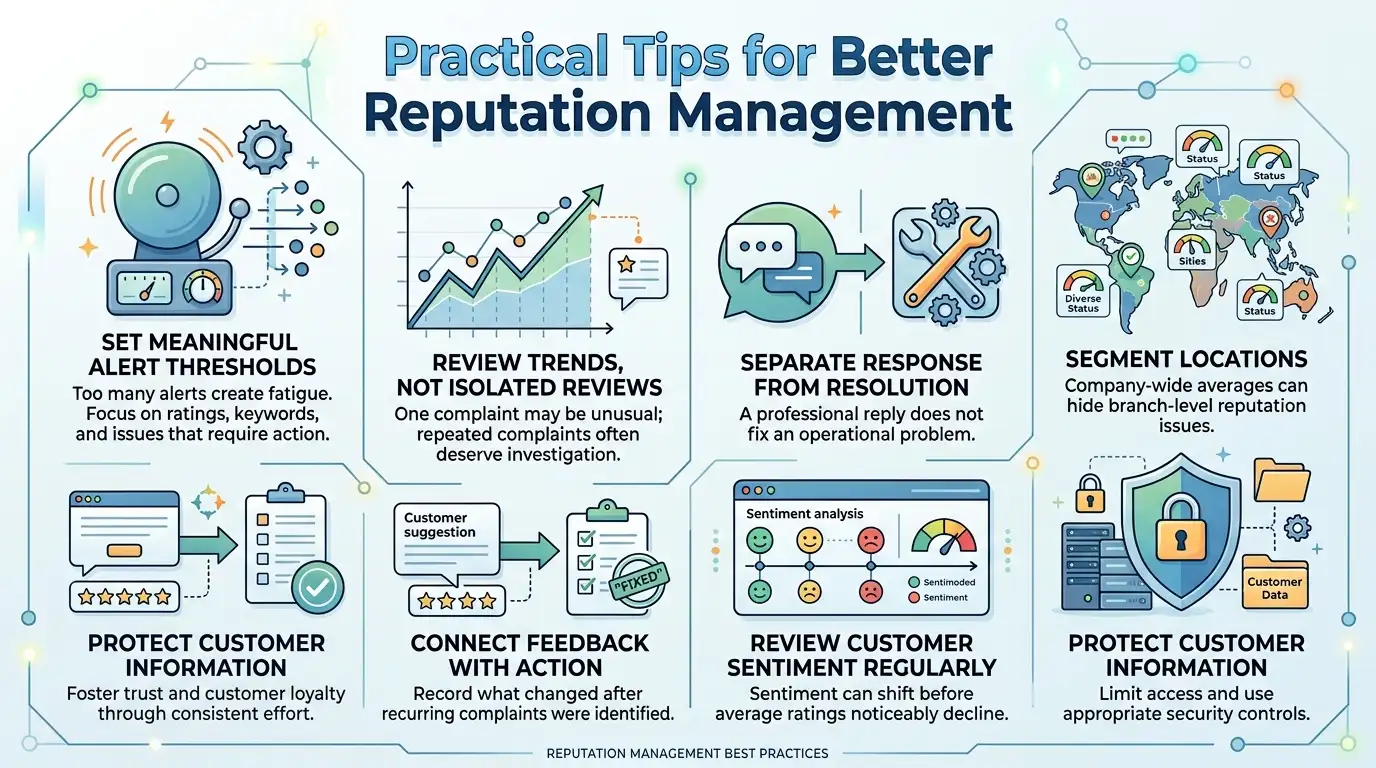
Practical Tips for Better Reputation Management
Set meaningful alert thresholds — Too many alerts create fatigue. Focus on ratings, keywords, and issues that require action.
Review trends, not isolated reviews — One complaint may be unusual; repeated complaints often deserve investigation.
Separate response from resolution — A professional reply does not fix an operational problem.
Segment locations — Company-wide averages can hide branch-level reputation issues.
Connect feedback with action — Record what changed after recurring complaints were identified.
Review customer sentiment regularly — Sentiment can shift before average ratings noticeably decline.
Protect customer information — Limit access and use appropriate security controls.
Common Mistakes to Avoid
Choosing software only because it has many features
Monitoring ratings without reading customer comments
Ignoring negative review trends
Responding with identical templates
Waiting too long to investigate serious complaints
Comparing locations without considering context
Creating excessive alerts
Focusing only on public reviews
Collecting feedback without acting on it
Ignoring customer-data security
The strongest reputation system is not the one that creates the most notifications.
It is the one that helps the right person take the right action at the right time.
Frequently Asked Questions
What is a reputation management tool?
It is software that helps businesses monitor reviews, analyze customer sentiment, manage responses, and improve their online reputation.
What should the best reputation management tool include?
It should include review monitoring, sentiment analysis, alerts, response management, analytics, and reputation reporting.
Can reputation management tools monitor negative reviews?
Yes, many platforms can detect low ratings, negative sentiment, keywords, and other signals that require attention.
Are reputation management tools useful for small businesses?
Yes, they can simplify review monitoring, customer response, and reputation tracking without requiring a large team.
Conclusion
The best reputation management tool should do more than display reviews or calculate an average rating.
It should help businesses monitor reputation, understand sentiment, detect negative trends, respond faster, compare locations, and turn customer signals into meaningful improvements.
For businesses in Pakistan, Trusted Optics combines reputation management, AI-powered analytics, collection, automation, real-time alerts, reporting, and multi-location capabilities in one platform.
If you want to build a more structured approach to customer review management, Contact Trusted Optics to discuss your requirements.
Author Bio
The Trusted Optics editorial team creates practical resources on customer feedback, review management, reputation, and customer experience, helping businesses turn customer insights into better decisions.
Written by
Alex Jones
Contributing writer sharing insights and expertise on customer experience and business growth.