A business can receive hundreds of customer responses and still miss the problem that matters most. Customer feedback trends reveal what individual comments often cannot: whether the same issue is happening repeatedly, whether customer sentiment is changing, and whether recent improvements are actually working.
For businesses in Pakistan, this can be especially useful across restaurants, retail stores, clinics, hotels, workshops, and service businesses where customer experiences can vary by location, team, product, or time of day.
What Are Customer Feedback Trends?
Customer Feedback Trends are recurring patterns in customer opinions, ratings, sentiment, complaints, and suggestions observed over a period of time. Instead of looking at individual responses separately, businesses analyze how feedback changes to identify recurring problems, improving experiences, emerging concerns, and differences between locations or customer touchpoints.
For example, one complaint about slow service may be isolated. But if similar comments appear every Friday evening for several weeks, the feedback has become a trend.
That distinction matters.
What Can Customer Feedback Trends Reveal?
Customer feedback becomes more useful when businesses stop asking only, “What did this customer say?” and start asking, “What keeps appearing across our feedback?”
Trends can reveal:
Recurring service problems
Changes in customer sentiment
Product or service weaknesses
Staff or department issues
Location-level differences
Changes in feedback volume
Response and engagement patterns
Customer expectations that are not being met
Whether operational changes are improving results
The value is not simply identifying what customers dislike. It is finding what deserves attention first.
1. Are Customer Ratings Actually Improving?
A rising average rating can look positive, but it does not tell the whole story.
Suppose a business moves from 4.1 to 4.4 stars. That looks like progress. However, if customers are still repeatedly complaining about delivery delays, the overall rating may be hiding a specific operational problem.
Look at ratings alongside:
Rating distribution
Feedback volume
Sentiment
Written comments
Complaint categories
Changes over time
This provides more context than a single average score.
2. What Is Customer Sentiment Saying?
Ratings tell you how customers scored an experience. Sentiment can help explain how they felt about it.
A business may notice that ratings remain relatively stable while negative sentiment around a specific topic is increasing.
For example:
“The food was good, but we waited almost 40 minutes.”
The rating may still be reasonable, but the comment reveals friction in the customer journey.
AI-powered sentiment analysis can help businesses identify themes across large volumes of feedback instead of manually reading every response. Trusted Optics currently provides AI sentiment analysis, trend detection, and insight generation.
3. Which Problems Keep Coming Back?
This is where feedback trends become operationally valuable.
Imagine a retail store receives these comments over several weeks:
“My size wasn't available.”
“Popular sizes are always out of stock.”
“I couldn't find my size again.”
These are different comments describing a similar problem: inventory availability.
Instead of treating them as three unrelated complaints, management can investigate stock planning, product demand, or replenishment.
Expert insight: A recurring moderate complaint can be more important than a single dramatic complaint because repetition indicates a process may be consistently failing.
4. Are Customers Responding to Your Improvements?
Feedback should not only identify problems. It should also help businesses determine whether their solutions worked.
Suppose a clinic receives repeated complaints about long waiting times.
Management changes appointment scheduling and staffing.
The next step is not simply to assume the problem is fixed.
Track feedback before and after the change.
If waiting-time complaints decrease and sentiment improves, the business has stronger evidence that the operational change helped.
This creates a useful cycle:
Feedback → Change → Measure → Compare → Improve
5. Which Locations Are Performing Differently?
Company-wide numbers can hide branch-level problems.
Consider a business with eight locations. Seven branches may have stable feedback while one location receives increasingly negative comments.
The overall business rating may still look healthy.
Multi-location analysis can reveal differences in:
Ratings
Feedback volume
Sentiment
Complaint themes
Department performance
Trends over time
Trusted Optics provides location comparison, department breakdowns, trend analysis, location insights, and reporting through its analytics dashboard features.
For Pakistani businesses operating across cities or multiple outlets, this can help management identify where attention is actually needed instead of applying the same solution everywhere.
6. Is Feedback Volume Changing?
Feedback volume itself is a useful signal.
A sudden increase could mean:
A new campaign increased customer engagement
A problem is affecting more customers
A new feedback channel is working
Customers have become more willing to share opinions
A sudden decrease can also raise questions.
Perhaps customers are less engaged, the feedback request is difficult to access, or staff are no longer encouraging customers to participate.
This is why Collection tools and analytics should be considered together.
Trusted Optics supports QR code generation and email surveys for collecting customer feedback, with location tracking and delivery-related controls.
7. What Do Customers Mention Without Being Asked?
Structured survey questions provide useful data, but open-ended comments often reveal unexpected issues.
A customer may mention:
Confusing payment instructions
Poor signage
Difficult parking
Staff communication
Delivery updates
Waiting-area conditions
These details may not appear in a standard satisfaction score.
A strong feedback strategy therefore combines quantitative data such as ratings and scores with qualitative feedback such as written comments.
How AI Can Help Find Feedback Trends
Manually identifying patterns across hundreds or thousands of responses can become difficult.
AI-assisted analysis can help group feedback around recurring themes, sentiment, and changes over time.
For example, customers may describe the same problem as:
“Slow response”
“Nobody replied”
“Support took too long”
“Had to follow up several times”
A trend-based analysis can recognize that these comments may point toward one broader issue: slow support communication.
The important part is what happens next.
AI can help surface the pattern, but managers still need to investigate the cause and decide what action makes sense.
Connect Feedback Trends with Real-Time Alerts
Trends often develop gradually, but some problems require immediate attention.
That is where real-time alerts complement trend analysis.
Trusted Optics provides email and SMS alerts for low ratings and critical feedback, with custom thresholds and keyword triggers.
A practical system can therefore work at two levels:
Alerts: Bring urgent feedback to attention quickly.
Trend analysis: Show whether the same issue is recurring over time.
One handles the immediate signal; the other reveals the bigger pattern.
From Feedback Trends to Business Decisions
Feedback becomes valuable when it changes what a business does.
For example:
Trend: Customers repeatedly mention slow checkout.
Possible action: Review staffing during peak hours.
Trend: One branch receives more complaints about staff communication.
Possible action: Review training and management processes at that location.
Trend: Customers increasingly praise a particular service feature.
Possible action: Identify whether the feature can be strengthened or promoted.
This is the difference between collecting feedback and using feedback as a business intelligence source.
Practical Tips for Tracking Feedback Trends
Track themes, not just scores
Group recurring complaints and suggestions instead of relying only on average ratings.
Compare time periods
Compare weekly or monthly patterns to identify meaningful changes.
Segment the data
Break feedback down by location, department, service, product, or customer touchpoint where relevant.
Combine ratings with comments
A score tells you what happened. Written feedback can help explain why.
Set meaningful alerts
Use thresholds and keywords for urgent issues rather than sending notifications for every minor change.
Measure after making changes
If you change a process, compare feedback before and after the change.
Close the feedback loop
Share important findings with the teams responsible for fixing the problem.
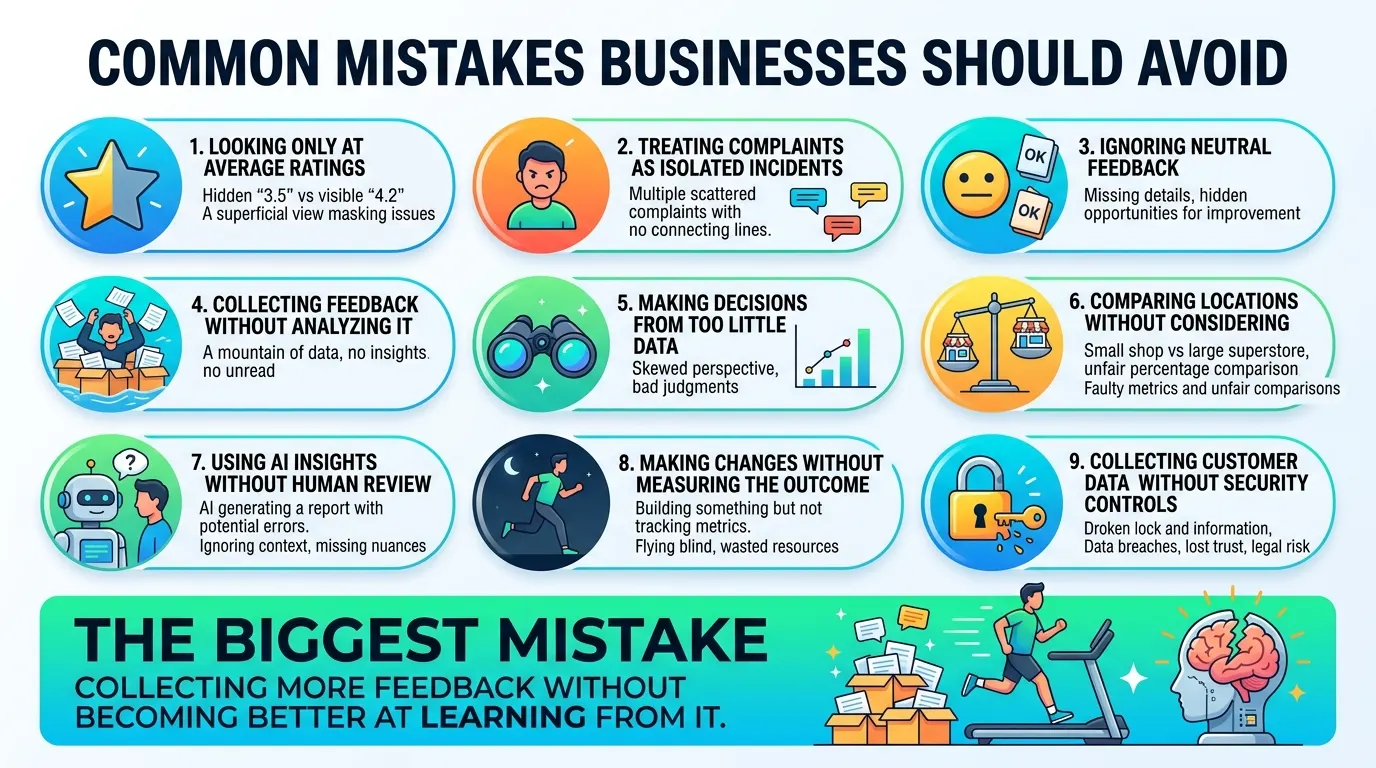
Common Mistakes Businesses Should Avoid
Looking only at average ratings
Treating every complaint as an isolated incident
Ignoring neutral feedback
Collecting feedback without analyzing it
Making decisions from too little data
Comparing locations without considering customer volume
Using AI insights without human review
Making changes without measuring the outcome
Collecting customer data without appropriate security controls
The biggest mistake is collecting more feedback without becoming better at learning from it.
Expert Insight
Customer feedback trends are most valuable when they connect customer experience with operational decisions.
Trusted Optics brings collection, analytics, reputation, and automation suite capabilities into one feedback workflow. The goal is not to create another dashboard for managers to check—it is to make recurring customer signals easier to identify, understand, and act on.
Frequently Asked Questions
What are Customer Feedback Trends?
Customer Feedback Trends are recurring patterns in customer ratings, comments, sentiment, complaints, and suggestions over time.
Why are Customer Feedback Trends important?
They help businesses identify recurring problems, changing customer expectations, and areas where customer experience is improving or declining.
How can businesses identify feedback trends?
Businesses can analyze ratings, comments, sentiment, feedback volume, and recurring themes using customer feedback software and analytics.
Can AI identify customer feedback trends?
Yes. AI-powered analysis can identify sentiment, themes, and recurring patterns across large volumes of customer feedback.
How should businesses act on feedback trends?
Identify the underlying issue, take a relevant operational action, and compare later feedback to determine whether the change improved the customer experience.
Real Customer Feedback
Trusted Optics has published feedback from customers describing how the platform supports feedback collection and customer understanding:
Taha K.: The platform makes it easy to collect customer feedback and understand what customers actually think about our service.
Amna Sheikh: It has made feedback collection more organized and helped us identify areas where we can improve the customer experience.
M. Omair: Trusted Optics has been very helpful for managing customer feedback.
These testimonials are published on Trusted Optics content and are included here as existing customer feedback rather than newly created quotes.
Conclusion
Customer feedback trends help businesses move beyond individual comments and understand the patterns shaping customer experience.
When ratings, sentiment, recurring themes, locations, and feedback volume are analyzed together, businesses can identify problems earlier, measure improvements, and make decisions based on what customers are actually experiencing.
For businesses in Pakistan, Trusted Optics combines feedback collection, AI-powered analytics, alerts, reporting, reputation management, and multi-location insights to help turn customer feedback into practical business action.
Don't just collect feedback. Find the pattern behind it—and act on what it tells you.
Author Bio
Trusted Optics creates practical resources on customer feedback, customer experience, analytics, and reputation management, helping businesses turn customer insights into better decisions.
Written by
Alex Jones
Contributing writer sharing insights and expertise on customer experience and business growth.