
A single negative review can make potential customers question a small business before they ever contact it. At the same time, many satisfied customers never leave feedback because nobody asks them. This is why Online Reputation Management for Small Business requires more than checking reviews occasionally.
For small businesses in Pakistan, a strong online reputation can influence trust, local visibility, and buying decisions. A structured system helps businesses collect customer feedback, respond to reviews, identify repeated problems, and improve the customer experience.
What Is Online Reputation Management for Small Business?
Online Reputation Management for Small Business is the process of monitoring, improving, and maintaining how a business appears online. It includes managing reviews, collecting customer feedback, responding to complaints, tracking customer sentiment, and using feedback to improve business operations.
It may include:
Google Business Profile reviews
Social media comments
Customer feedback surveys
Online ratings
Brand mentions
Customer complaints
Website testimonials
The goal is not to hide negative feedback. The goal is to understand customer experiences and respond professionally.
1. Audit Your Current Online Reputation
Before improving your reputation, understand what customers currently see online.
Search for:
Your business name
Business name + city
Business name + reviews
Business name + complaints
Check:
Average rating and review volume
Recent and unanswered reviews
Common complaints
Repeated positive feedback
Outdated business information
Expert Insight: One negative review may be isolated, but repeated complaints about the same issue often reveal an operational problem. For example, frequent comments about slow service may indicate a process issue that needs fixing.
2. Make Feedback Easy to Share
Satisfied customers may not leave reviews if the process takes too much effort.
Use collection tools such as:
QR codes
SMS requests
Email follow-ups
Website forms
Digital receipts
Timing matters too. Request feedback shortly after a meal, purchase, delivery, or completed service while the experience is still fresh.
3. Create a Simple Feedback Process
A consistent workflow helps businesses manage customer sentiment more effectively:
Collect feedback.
Identify positive and negative experiences.
Respond to public reviews.
Address private complaints.
Identify recurring problems.
Improve business processes.
Measure results.
Customer Experience → Feedback → Analysis → Improvement
This approach is more valuable than simply trying to increase review volume.
4. Respond to Reviews Professionally
Potential customers often notice how a business handles criticism.
Good review responses should be:
Respectful
Timely
Specific
Focused on resolution
For negative reviews, acknowledge the concern, avoid public arguments, and explain the next step. Avoid using the same generic response for every customer.
5. Use Reputation Management Tools to Identify Patterns
Manually checking multiple platforms becomes difficult as a business grows.
Reputation management tools can help monitor:
Online reviews
Customer feedback
Sentiment trends
Review responses
Location performance
They can also reveal:
Common complaints
Best-performing services
Increasing negative feedback
Slow response times
Locations needing attention
This turns reputation management into a business improvement process.
6. Use an Analytics Dashboard to Understand Customer Sentiment
An average rating does not tell the whole story.
An analytics dashboard can track:
Average rating
Review volume
Response rate and time
Customer satisfaction
Net Promoter Score
Positive and negative sentiment
Common complaint categories
Practical Tip: Repeated complaints can reveal problems before your overall rating declines. For example, frequent comments about delivery delays should be addressed early.
7. Automate Repetitive Reputation Tasks
Manually sending every feedback request can become inconsistent.
An automation suite can help with:
Feedback scheduling
SMS and email follow-ups
Review reminders
Internal notifications
Feedback categorization
Automation should improve consistency without making communication feel robotic. The best automation feels timely and relevant to the customer.
8. Improve the Customer Experience Behind the Reviews
Reputation management cannot permanently fix poor service.
If customers repeatedly complain about:
Slow service
Late delivery
Poor communication
Unclear pricing
Product quality
Difficult returns
The underlying problem must be addressed.
Customer review management software can help businesses collect feedback, monitor reviews, analyze sentiment, identify recurring problems, and track reputation performance.
The goal is to improve the experience that creates the reviews.
9. Consider Long-Term Platform Performance
When choosing reputation management software, look beyond the initial feature list.
Consider whether the platform supports:
Growing review volume
Multiple locations
Organized customer data
Reliable reporting
Easy team access
Secure information handling
The best platform is not always the one with the most features. It is the one your team can use consistently without unnecessary complexity.
10. Compare Cost with Business Value
The cost of reputation management software should be compared with the potential cost of poor reputation management.
Potential losses may include:
Lost customers
Unanswered complaints
Missed feedback
Manual staff time
Repeated service problems
A platform can provide stronger value when it reduces manual work, automates feedback requests, identifies recurring complaints, and tracks customer sentiment.
11. Follow Privacy and Ethical Best Practices
Customer feedback may include personal information, so businesses should handle it responsibly.
Best practices include:
Collect only necessary information.
Protect customer details.
Use secure access controls.
Limit employee access when appropriate.
Review platform privacy and security practices.
Avoid fake reviews, misleading feedback practices, or impersonating customers. Long-term reputation is built on trust.
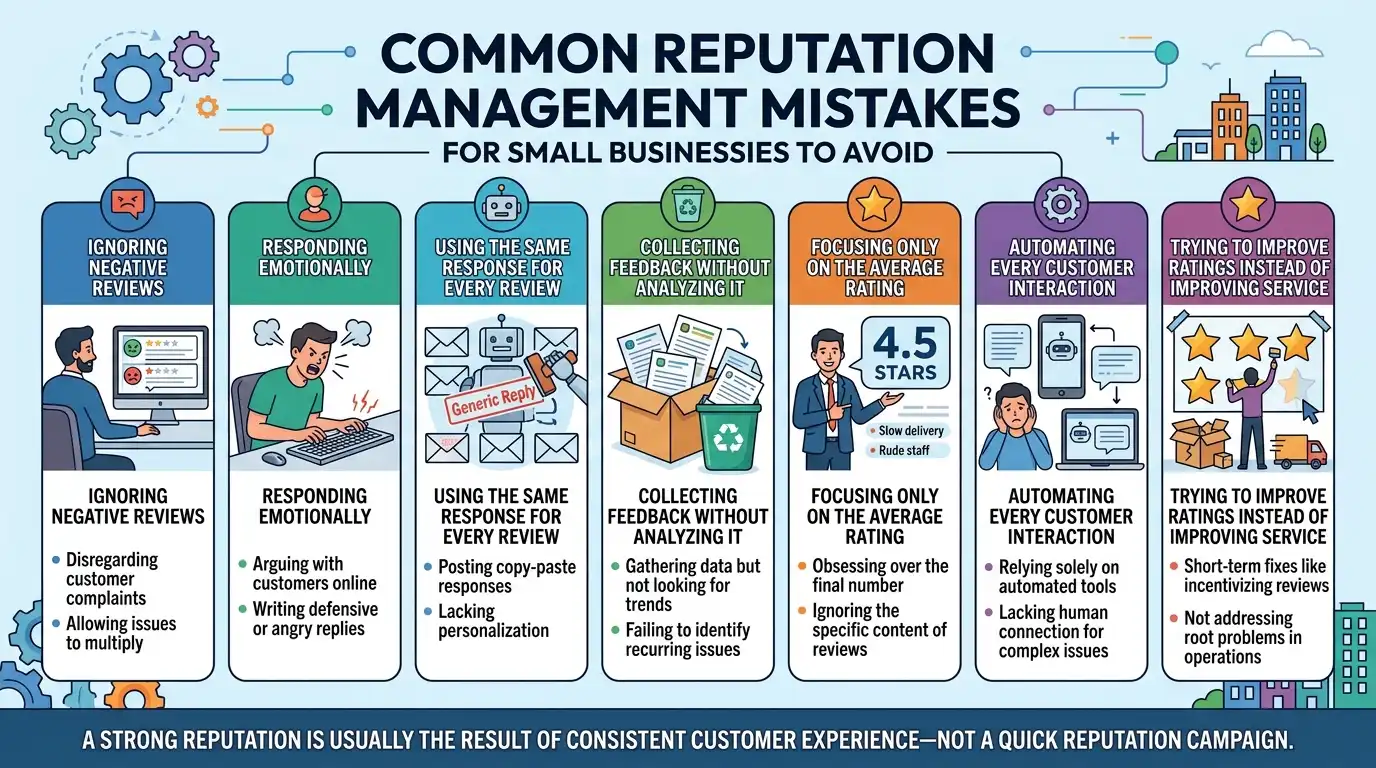
Common Reputation Management Mistakes
Small businesses should avoid:
Ignoring negative reviews
Responding emotionally
Using the same response for every review
Collecting feedback without analyzing it
Focusing only on the average rating
Automating every customer interaction
Trying to improve ratings instead of improving service
A strong reputation is usually the result of consistent customer experience—not a quick reputation campaign.
Expert Tips Many Small Businesses Overlook
Track repeated complaint themes, not only the number of complaints.
Monitor response time because customers often judge how quickly a business reacts.
Compare feedback between different locations, teams, or services.
Review recent feedback against older feedback to measure improvement.
Use the exact language customers use to identify hidden service problems.
Create an escalation process for serious complaints.
Focus on service quality instead of chasing perfect ratings.
Customer Testimonials
A structured feedback process helped us understand repeated customer concerns instead of dealing with every complaint separately.
— Small Business Owner, Pakistan, Karachi
The biggest improvement was consistency. We became better at collecting feedback and responding to customers.
— Retail Business Manager, Pakistan, Karachi
Customer feedback became more useful once we started looking at patterns instead of focusing only on individual reviews.
— Service Business Owner, Pakistan, Lahore
Replace these placeholders with verified customer testimonials before publication if actual customer details are available.
Frequently Asked Questions
What is Online Reputation Management for Small Business?
It is the process of monitoring reviews, collecting feedback, responding to customers, and improving customer experiences to build a stronger online reputation.
Why is online reputation important for small businesses?
Online reviews and customer feedback can influence customer trust and buying decisions.
How can small businesses improve their online reputation?
They can collect feedback, respond to reviews, address recurring problems, and improve the customer experience.
What are reputation management tools?
These tools help businesses monitor reviews, collect feedback, analyze customer sentiment, and manage reputation-related activities.
Can customer review management software help small businesses?
Yes. It can help businesses collect feedback, monitor reviews, analyze customer insights, and manage reputation more consistently.
Conclusion
Improving online reputation management for small business requires a consistent process, not occasional review checking.
Businesses should:
Make feedback easy to provide.
Respond to reviews professionally.
Monitor customer sentiment.
Identify repeated problems.
Use automation where it saves time.
Improve the customer experience behind the feedback.
For businesses in Pakistan, the right combination of collection tools, reputation management tools, an analytics dashboard, and an automation suite can make reputation management more organized and actionable.
With Trusted Optics, businesses can build a more structured approach to customer feedback, review management, customer insights, and online reputation improvement.
About the Author
This article was written by the Feynix Solution content team for Trusted Optics. The team specializes in customer feedback management, online reputation, customer experience, review collection strategies, and reputation management solutions for modern businesses.
Written by
Alex Jones
Contributing writer sharing insights and expertise on customer experience and business growth.