A customer can buy from your business once and still never return. The difference is often not the product alone—it is how the entire experience made them feel. What Is Customer Satisfaction? It is the measure of how well a business meets or exceeds customer expectations throughout the buying and service journey.
A customer may be satisfied because the product worked as expected, support responded quickly, or the business resolved a problem fairly. On the other hand, a single unresolved complaint, confusing process, or poor communication can quickly reduce satisfaction.
For businesses in Pakistan and other competitive markets, understanding customer satisfaction is essential for improving customer retention, strengthening online reputation, and making better decisions based on real customer feedback.
What Is Customer Satisfaction?
Customer satisfaction is how well a business, product, service, or interaction meets a customer's expectations. When the experience meets or exceeds expectations, satisfaction is usually higher; when it falls short, customers may complain, leave negative reviews, or switch to another business.
Customer satisfaction can be influenced by the complete customer journey, including:
Finding business information
Making a purchase or booking
Receiving the product or service
Contacting customer support
Resolving complaints
Receiving follow-up communication
Why Is Customer Satisfaction Important for Businesses?
Customer satisfaction influences repeat purchases, referrals, reviews, and customer retention. While unhappy customers may not always complain, they may simply stop buying.
Customer satisfaction data helps businesses identify:
Repeated service issues
Poor support experiences
Product or service concerns
Delivery or communication delays
Customer expectations
Reasons for negative reviews
Expert Insight
One of the biggest mistakes businesses make is treating customer satisfaction as a final score instead of an ongoing business signal.
A satisfaction score tells you what happened. Customer comments often help explain why it happened.
For example, a restaurant may receive an average CSAT score of 4 out of 5. That appears positive. However, customer comments may reveal that several customers are unhappy with waiting times during weekends. Without reading the feedback, the business may miss an operational problem.
What Factors Affect Customer Satisfaction?
Customer satisfaction depends on the complete customer experience, not just product or service quality. Key factors include:
Product or Service Quality: Delivering what was promised helps meet customer expectations.
Customer Service: Fast, clear, and helpful support can improve satisfaction, especially when problems occur.
Speed and Convenience: Simple processes, quick responses, and shorter wait times create a better experience.
Communication: Clear updates about orders, delays, and issues help reduce frustration.
Value for Money: Customers judge whether the overall experience was worth the price paid.
Problem Resolution: Understanding the issue, responding quickly, offering a realistic solution, and following up can turn a negative experience into a positive one.
How Is Customer Satisfaction Measured?
Businesses measure customer satisfaction through surveys, ratings, reviews, direct feedback, and customer behavior. Common methods include:
CSAT: Measures satisfaction after a specific interaction, purchase, or service experience.
Customer Feedback Surveys: Collect direct opinions through short, relevant questions sent at the right time.
Online Reviews: Reveal what customers value, recurring problems, and whether expectations are being met. Customer review management software can help businesses organize and monitor this feedback.
Customer Effort Score (CES): Measures how easy or difficult it was for customers to complete a task or resolve an issue.
Using multiple methods gives businesses a clearer view of customer satisfaction than relying on one metric alone.
Customer Satisfaction vs Customer Experience
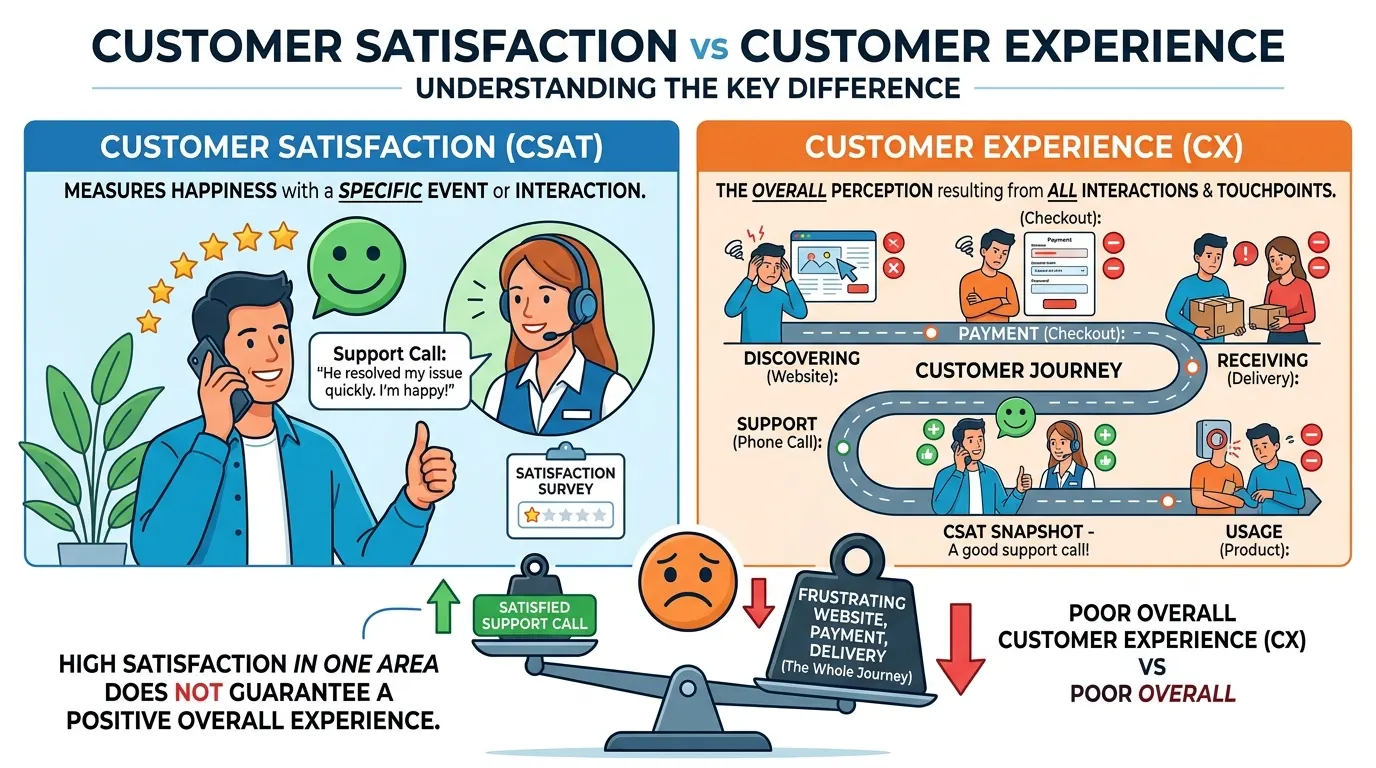
Customer satisfaction and customer experience are closely related, but they are not exactly the same.
Customer satisfaction measures how happy or unhappy a customer is with a specific experience.
Customer experience refers to the complete journey a customer has with a business across multiple interactions.
For example, a customer may be satisfied with a single support call but still have a poor overall experience because the website, payment process, and delivery were difficult.
Practical Example
A Pakistani e-commerce customer may receive excellent support after a delayed delivery. The support interaction may receive a high satisfaction score.
However, if the order was difficult to place, the delivery was late, and the customer received no updates, the overall customer experience may still be negative.
This is why businesses should measure both individual interactions and the broader customer journey.
How Customer Feedback Helps Improve Satisfaction
Customer feedback is most valuable when businesses act on it.
Collecting feedback without reviewing or using it creates little business value.
A practical feedback process can include:
Collect feedback after important customer interactions.
Organize responses by location, department, product, or issue.
Identify repeated patterns instead of reacting to one isolated comment.
Prioritize problems based on frequency and business impact.
Make operational changes where necessary.
Measure customer satisfaction again to see whether the change worked.
Expert Tip
Do not focus only on your average satisfaction score.
Averages can hide important problems. A business may have a strong overall score while one location, product category, or customer segment is experiencing repeated dissatisfaction.
Segmented feedback often provides more useful information than a single company-wide number.
How Technology Can Help Businesses Track Customer Satisfaction
As businesses grow, customer feedback can become scattered across reviews, social media, email, SMS, QR codes, website forms, and support conversations.
Customer feedback platforms help organize this information through:
Collection Tools: Gather feedback through channels such as QR codes, surveys, SMS, and email.
Reputation Management Tools: Monitor reviews and identify recurring issues across locations.
Analytics Dashboard: Track satisfaction scores, feedback trends, locations, and common complaints.
Automation Suite: Send timely feedback requests while keeping communication relevant and easy to complete.
A structured system helps businesses turn scattered feedback into useful customer satisfaction insights.
Customer Satisfaction: Cost vs Value
Customer satisfaction programs may seem like an added cost, but ignoring customer dissatisfaction can lead to churn, negative reviews, poor word-of-mouth, and repeated service problems.
The real value comes from turning feedback into action. For example, identifying a confusing process can help reduce support requests and improve customer satisfaction.
The goal is not to collect more feedback—it is to collect useful feedback and act on it.
Common Customer Satisfaction Measurement Mistakes
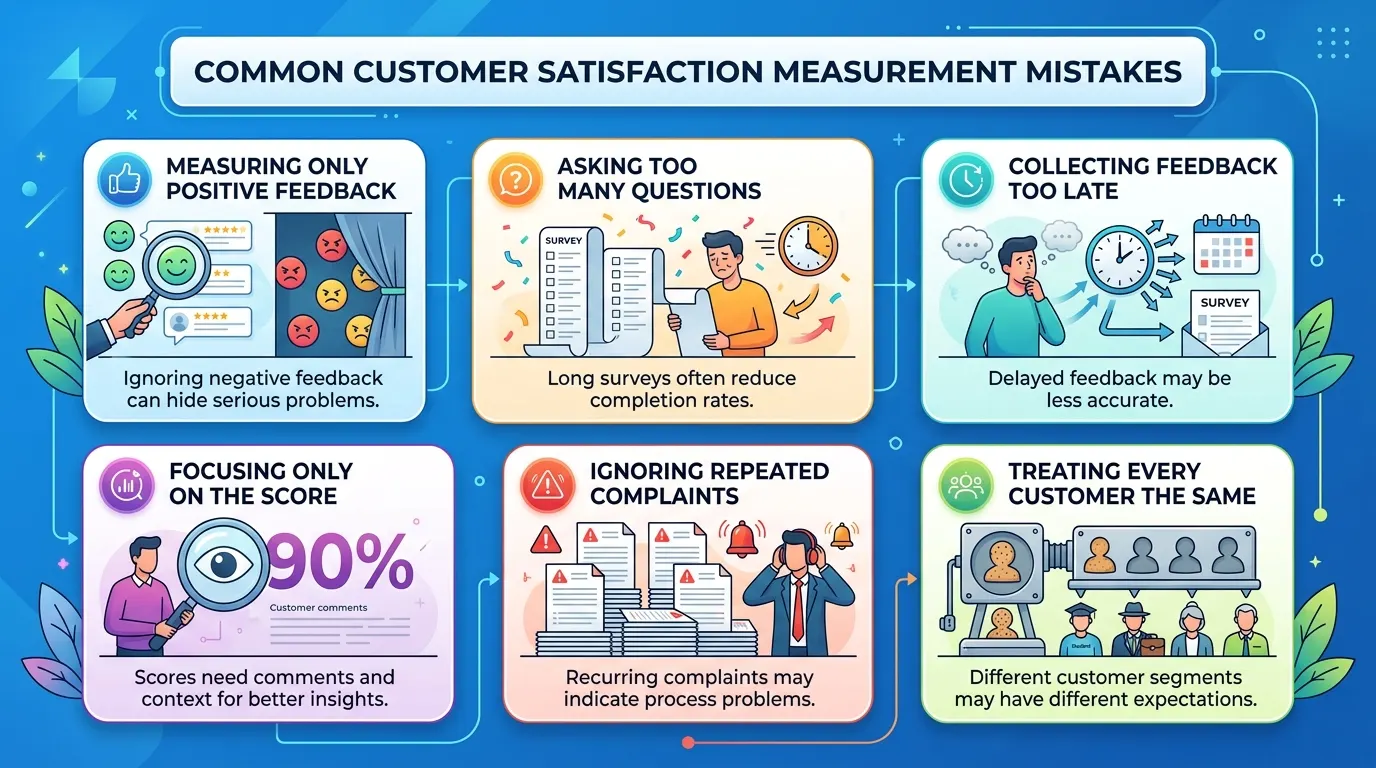
Measuring Only Positive Feedback: Ignoring negative feedback can hide serious problems.
Asking Too Many Questions: Long surveys often reduce completion rates.
Collecting Feedback Too Late: Delayed feedback may be less accurate.
Focusing Only on the Score: Scores need comments and context for better insights.
Ignoring Repeated Complaints: Recurring complaints may indicate process problems.
Treating Every Customer the Same: Different customer segments may have different expectations.
Practical Tips to Improve Customer Satisfaction
Businesses can improve customer satisfaction by focusing on the areas customers experience most often.
Make important processes easier to complete.
Set realistic expectations before a purchase.
Respond to customer problems quickly.
Give customers clear updates when delays occur.
Use feedback to identify repeated problems.
Track satisfaction trends over time.
Review negative feedback without becoming defensive.
Train employees to resolve common customer issues.
Measure whether operational changes actually improve satisfaction.
Use customer review management software when feedback and reviews become difficult to manage manually.
An Important Practical Insight
The fastest improvement does not always come from making major changes.
Sometimes, small changes have a significant effect on customer satisfaction.
For example:
Adding an order update can reduce uncertainty.
Simplifying a form can reduce customer effort.
Improving response times can prevent frustration.
Explaining a delay honestly can protect trust.
Businesses should first identify the specific point where customers experience friction before investing in broad changes.
Customer Satisfaction Testimonials
Organizing customer feedback helped us identify common issues instead of relying on assumptions.
— Business Customer
Tracking feedback patterns over time showed us which areas needed attention.
— Service Business Customer
Focusing on repeated customer concerns helped us make better business decisions.
— Business Customer
Frequently Asked Questions
What is customer satisfaction in simple words?
Customer satisfaction is how well a business meets or exceeds customer expectations.
Why is customer satisfaction important?
It can influence customer loyalty, repeat purchases, referrals, reviews, and business reputation.
How do businesses measure customer satisfaction?
Businesses use CSAT surveys, feedback forms, reviews, ratings, and Customer Effort Score.
How can businesses improve customer satisfaction?
Businesses can improve it by understanding customer needs, reducing friction, and acting on feedback.
Conclusion
What Is Customer Satisfaction? It is more than a score or positive review. It shows how customers evaluate their overall experience with a business.
By collecting and analyzing feedback, businesses in Pakistan can identify customer needs, fix recurring problems, and improve service quality. Tools like Trusted Optics help organize feedback, support reputation management, and turn customer insights into better business decisions.
Author Bio
This article was written by the content team at Feynix Solution, a digital marketing and SEO company focused on creating helpful, research-driven content for SaaS and technology brands. The team develops human-first content strategies that connect search intent with real business needs.
Written by
Alex Jones
Contributing writer sharing insights and expertise on customer experience and business growth.