A great shopping experience can turn a first-time buyer into a loyal customer. But a slow checkout, poor service, or unresolved complaint can have the opposite effect. Customer experience tools for retail businesses help retailers collect customer feedback, understand satisfaction levels, manage reviews, and identify areas that need improvement.
For retail businesses in Pakistan, these tools are becoming more useful as customers interact with brands through physical stores, websites, social media, WhatsApp, delivery services, and online reviews.
The goal is not simply to collect more feedback. It is to understand what customers are experiencing and take action before small problems become bigger ones.
What Are Customer Experience Tools for Retail Businesses?
Customer experience tools are software solutions that help retailers collect, analyze, and manage customer interactions across different touchpoints.
Common features include:
Feedback collection and surveys
QR code feedback systems
Reputation management
Customer satisfaction analytics
Automated alerts and follow-ups
Review monitoring
Sentiment analysis
Multi-location reporting
A good platform connects these activities so businesses can follow a simple process:
Collect → Analyze → Act → Improve
Why Retail Businesses Need Customer Experience Tools
Retail customer experience is influenced by many small details. Customers may like a product but dislike the checkout process. They may appreciate the staff but complain about product availability.
Without structured feedback, these patterns can remain hidden.
Customer experience software helps retailers:
Identify recurring complaints
Measure customer satisfaction
Monitor online reputation
Detect service problems quickly
Compare store locations
Reduce manual feedback work
Make decisions using customer data
Expert Insight
The biggest mistake retailers make is treating feedback collection as the end goal.
Feedback only becomes valuable when it leads to action.
If customers repeatedly complain about long checkout times, the business should investigate staffing, queues, or payment processes instead of simply collecting more ratings.
4 Important Customer Experience Tools for Retail
Collection tools make it easier for customers to share their opinions through:
QR codes
SMS
Email surveys
Digital feedback forms
Post-purchase requests
A QR code feedback system is particularly useful for physical retail stores. A customer can scan a QR code at checkout, rate the experience, and leave a comment within seconds.
Trusted Optics provides feedback collection features including QR codes, email surveys, custom branding, and location-based feedback tracking.
2. Reputation Management Tools
Customer experience continues after the customer leaves your store.
Online reviews can influence whether new customers decide to visit or purchase. Reputation management tools help retailers monitor customer sentiment and manage review-related activity.
Useful features include:
Review monitoring
Review requests
Negative feedback alerts
Customer complaint capture
Review analytics
Response management
For retailers, the practical benefit is early visibility into customer problems before they affect the wider reputation of the business.
Collecting hundreds of responses is not useful if managers cannot identify patterns.
An analytics dashboard tool converts feedback into measurable insights, such as:
Satisfaction trends
Positive and negative feedback
Common complaints
Location performance
Customer sentiment
Review activity
For example, if four stores maintain strong satisfaction scores but one location consistently receives complaints about staff service, management can investigate that specific branch instead of changing operations across every store.
Manual follow-ups become difficult when customer volumes increase.
An automation suite can help businesses trigger actions based on customer responses, including:
Feedback requests
Email notifications
SMS alerts
Negative-rating alerts
Follow-up messages
Automated reports
For example, a low customer rating could automatically alert the relevant store manager so the issue can be reviewed while the experience is still recent.
How a QR Code Feedback System Improves Retail CX
A QR code feedback system connects the physical shopping experience with digital feedback collection.
A simple process looks like this:
Customer shops → Scans QR code → Gives feedback → System analyzes response → Manager takes action
Retailers can place QR codes on:
Checkout counters
Receipts
Shopping bags
Product packaging
Customer service desks
Promotional cards
However, placing QR codes everywhere is not the answer.
Expert tip: Put the QR code where customers naturally pause and clearly explain what they will get by scanning it, such as “Tell us about your shopping experience.”
What Should Retailers Check Before Choosing a Tool?
Software does not have physical durability, thickness, or wear layers like building materials. For CX platforms, the equivalent performance factors are reliability, security, scalability, usability, and long-term value.
Before choosing a platform, consider:
Reliability: Does it work consistently during daily operations?
Security: Are customer data and accounts properly protected?
Scalability: Can it support multiple stores and higher feedback volumes?
Mobile performance: Is the feedback process easy on smartphones?
Analytics: Can managers quickly understand the results?
Automation: Can repetitive tasks be reduced?
Integration: Can it fit into existing business workflows?
Support: Is help available when problems occur?
Cost vs. Value
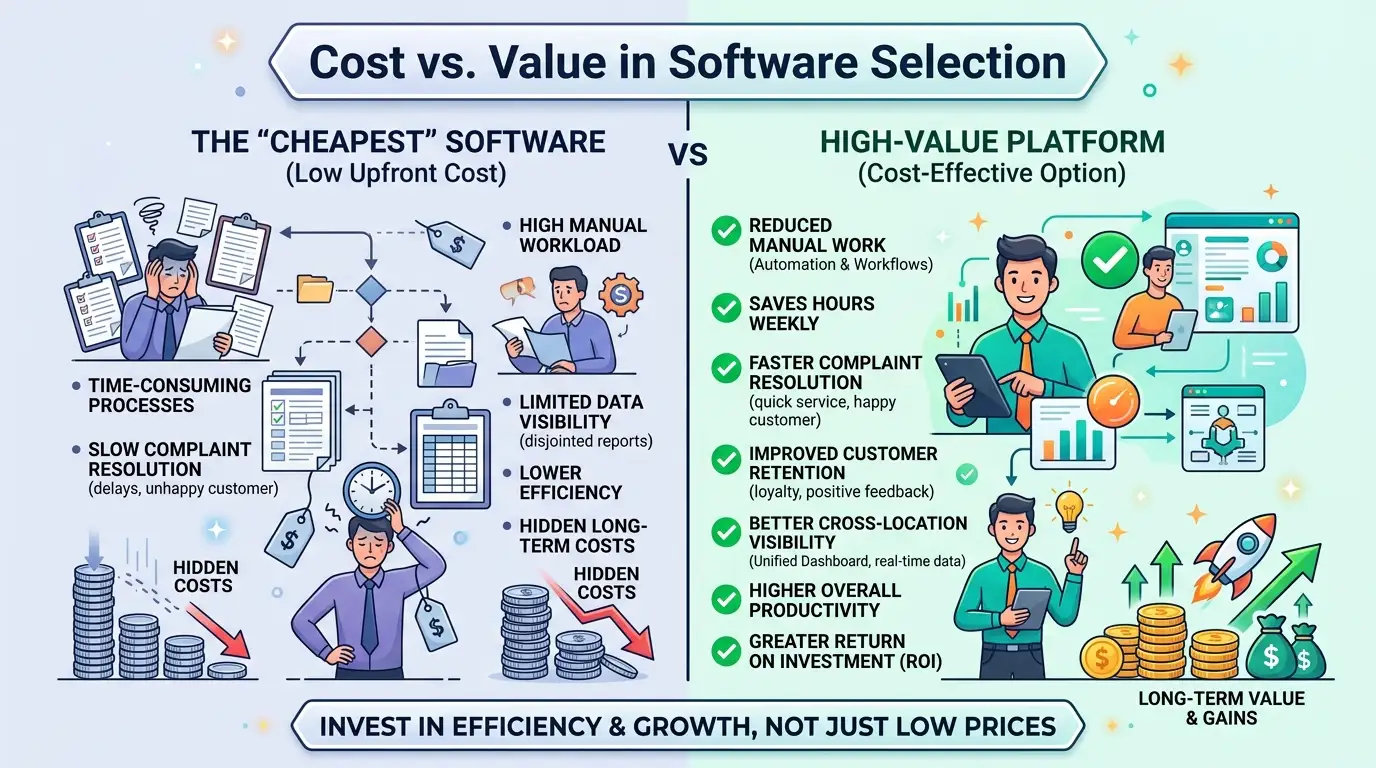
The cheapest software is not always the most cost-effective option.
Consider the total value of the platform, including reduced manual work, faster complaint resolution, improved customer retention, and better visibility across locations.
A tool that saves staff several hours every week may provide greater value than a cheaper platform that requires everything to be managed manually.
Practical Example for a Pakistani Retail Business
Imagine a clothing retailer operating three stores in Karachi.
Management notices that repeat customers are declining but does not know why.
The retailer introduces a QR code feedback system at checkout with three simple questions:
How would you rate your shopping experience?
Was our staff helpful?
What could we improve?
After several weeks, the analytics show that one location receives significantly more complaints about waiting times.
Management investigates and discovers that the branch has fewer checkout staff during busy evening hours.
The solution is operational—not promotional.
The retailer adjusts staffing and continues monitoring feedback to see whether satisfaction improves.
This is the real value of customer experience technology: it helps businesses find problems that customers are already experiencing but management may not see.
Common Mistakes Retailers Should Avoid
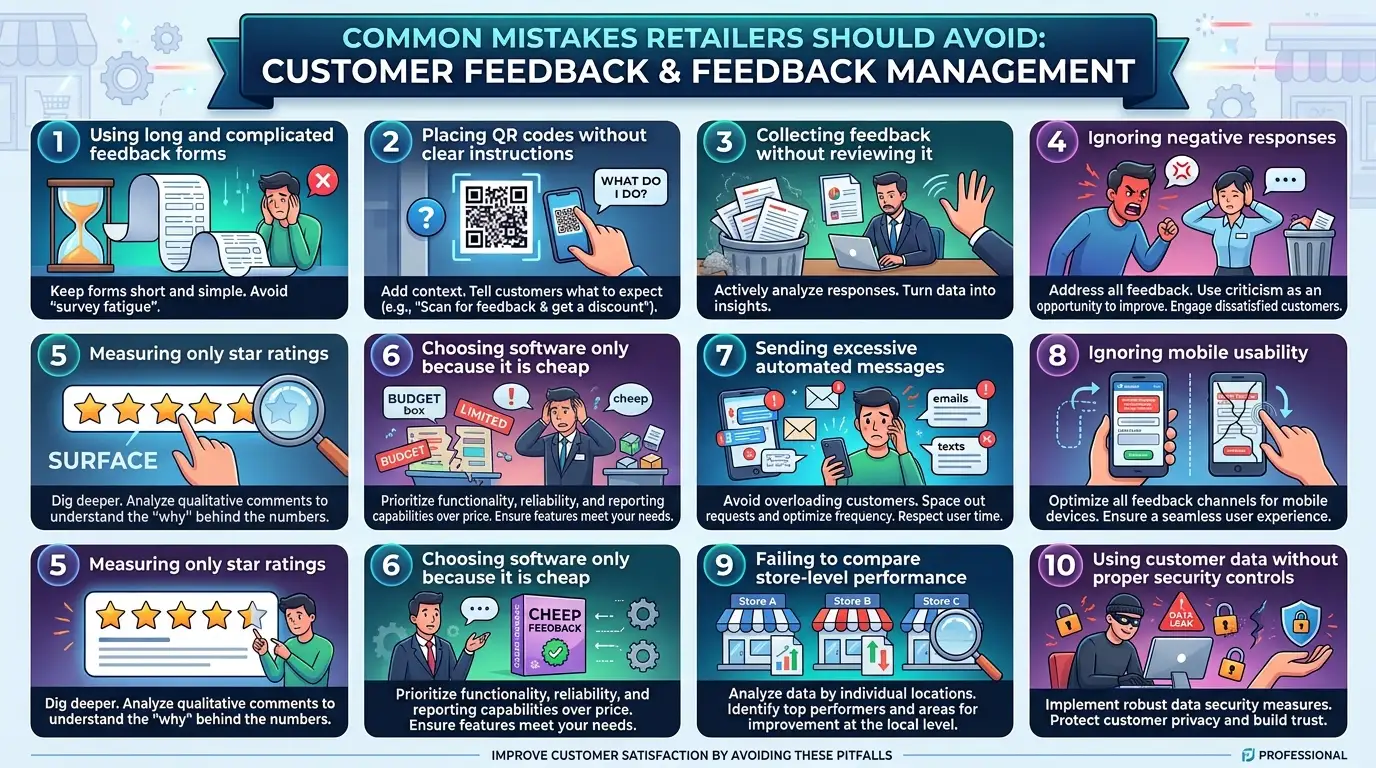
Using long and complicated feedback forms
Placing QR codes without clear instructions
Collecting feedback without reviewing it
Ignoring negative responses
Measuring only star ratings
Choosing software only because it is cheap
Sending excessive automated messages
Ignoring mobile usability
Failing to compare store-level performance
Using customer data without proper security controls
Customer Testimonials
Basit CH, Retailer, Karachi:
Trusted Optics makes collecting customer feedback simple and helps us understand what our customers really need.
Kashif Hashmi, Supermarket, Karachi:
Trusted Optics helps us identify customer concerns faster and improve our overall shopping experience.
Asma Ejaz, Clothing Boutique, Lahore:
The insights from Trusted Optics help us better understand our customers and make smarter service decisions.
Frequently Asked Questions
What are customer experience tools for retail businesses?
Customer experience tools for retail businesses help retailers collect feedback, measure satisfaction, manage reviews, and understand customer needs.
What is the best customer experience tool for retail?
The best tool should offer easy feedback collection, analytics, automation, security, and scalability.
How does a QR code feedback system help retailers?
It lets customers quickly share feedback and helps retailers identify service issues in real time.
Are customer experience tools useful for small retailers?
Yes, customer experience tools for retail businesses help small retailers collect customer insights, identify problems, and improve service efficiently.
Conclusion
The best Customer Experience Tools for Retail Businesses are not necessarily those with the most features. They are the tools that help retailers understand customers, identify recurring problems, and take action.
For Pakistani retailers, combining collection tools, a QR code feedback system, reputation management tools, analytics, and automation can create a more structured customer experience strategy.
Trusted Optics provides tools for feedback collection, QR codes, analytics, reputation management, alerts, reporting, and multi-location customer experience management.
The real advantage is simple: collect feedback, understand it, and act on it before customers choose another business.
About the Author
This article was prepared by the Feynix Solution content team, which manages content and SEO for Trusted Optics and creates practical resources on customer feedback, customer experience, review management, and reputation management.
Written by
Alex Jones
Contributing writer sharing insights and expertise on customer experience and business growth.